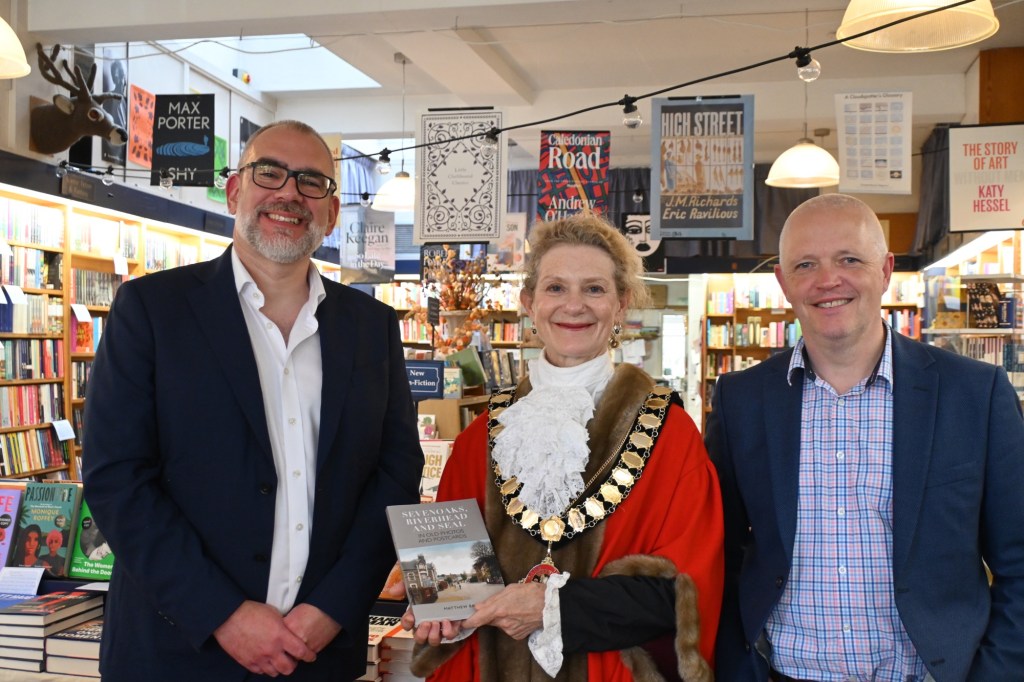
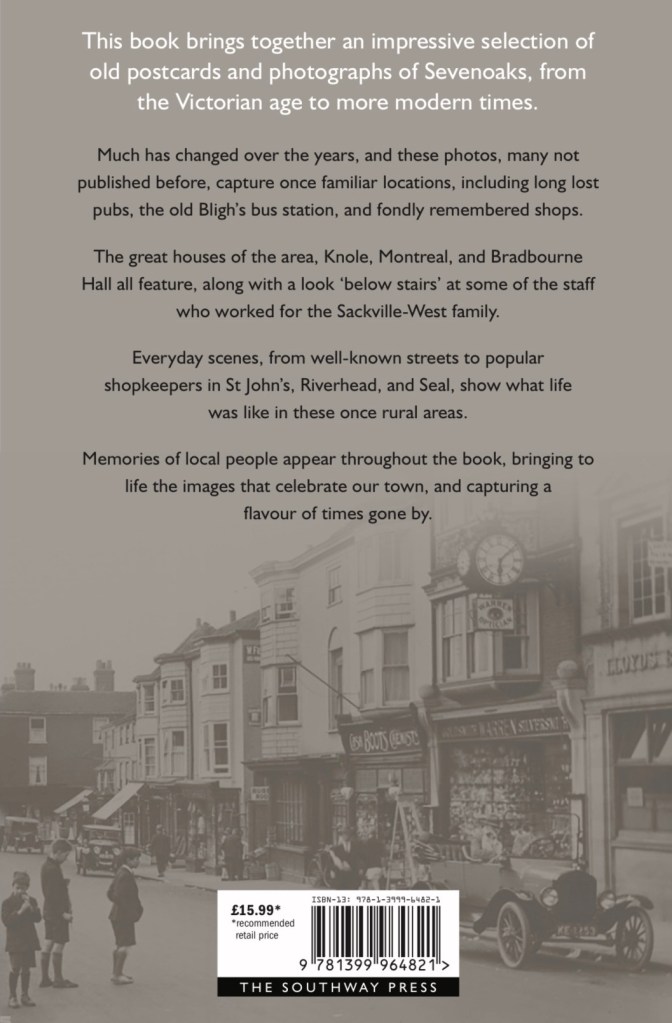
I’m really excited to reveal the cover for my new book here today.
Sevenoaks, Riverhead and Seal in Old Photos and Postcards, will be available from Sevenoaks Bookshop, from me direct (email 7oakspostcardbook@gmail.com) and other places in town.
If you’d like a signed copy, then it’s probably best to order from me, although I will be doing a signing event at the bookshop later in October, when it will be great to meet as many of you who can make it – details coming soon!
If you live outside the UK then you can order from the bookshop by emailing enquiries@sevenoaksbookshop.co.uk and they will quote on postage.
The book is a culmination of over two years work, and includes photos I’ve used on this page as well as lots of new ones. It also includes many of your comments. If I asked to use your comment and you gave permission, then you’re in the book, so a huge thank you to those that did!
The book was also sponsored in part by Sevenoaks Town Council and Wealden Properties. Many of the properties that feature in this book were acquired and developed by Bill Terry and he was a popular and well-known figure in the community. Bill passed away in August 2023 at the age of eighty-nine, and I am pleased that Wealden Properties has sponsored the book in his memory
I can’t wait for you to buy a copy and hear what you think.
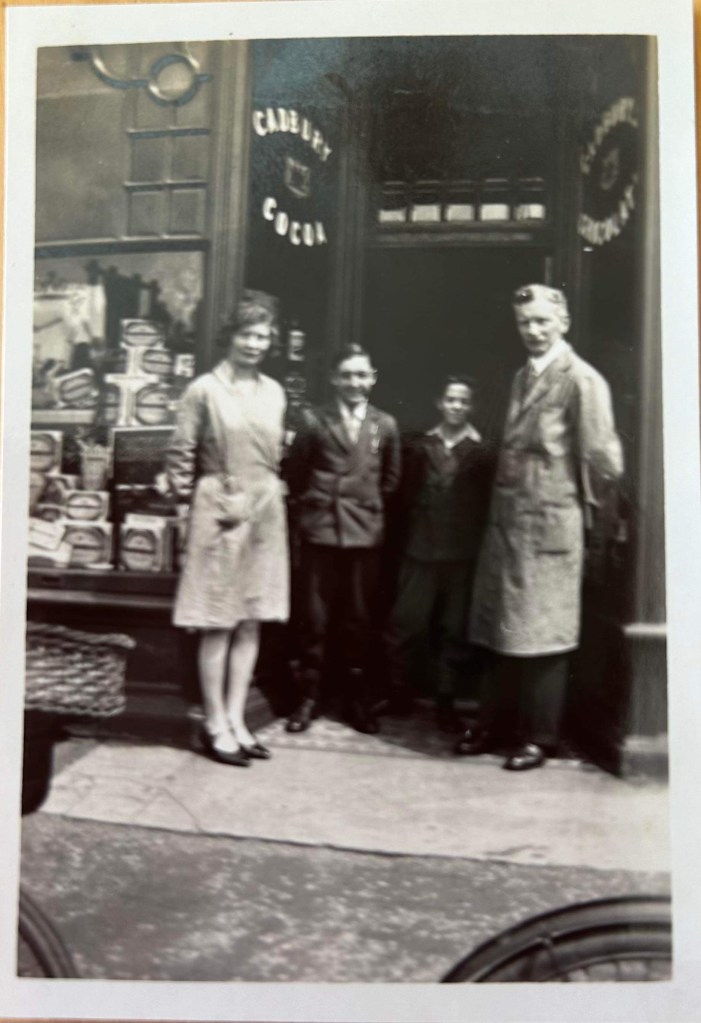
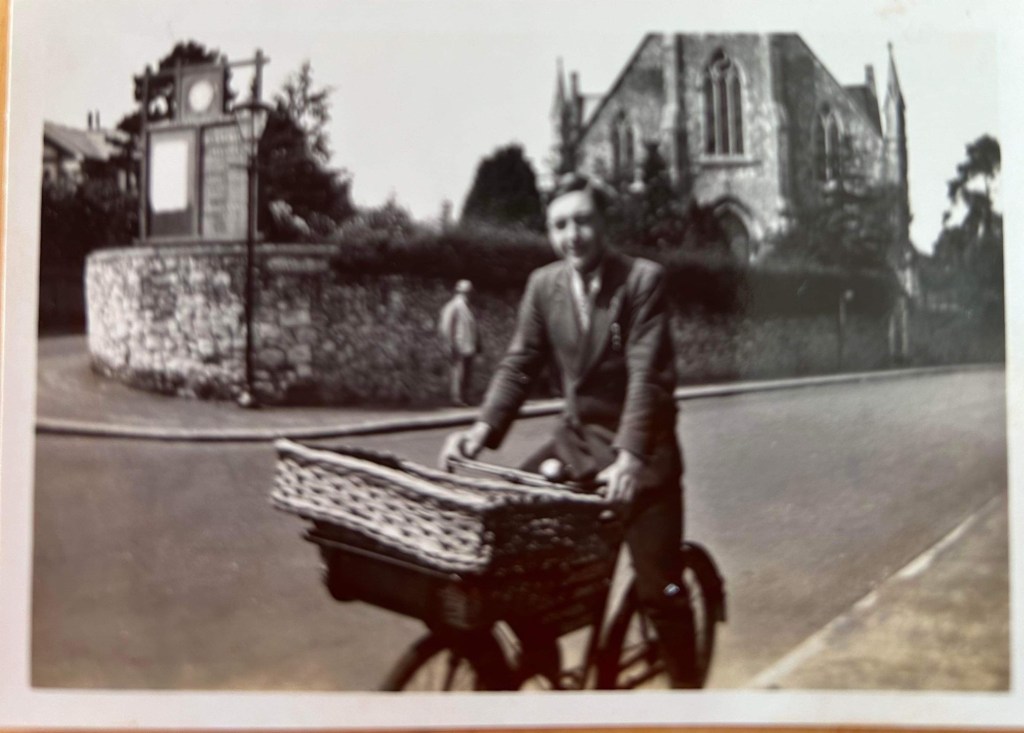
One follower of the History Hub Facebook page has sent some photos of 6, St John’s Hill, a shop which was run for many years by his great grandfather, George Harry Mullen.
Before Mr Mullen took over the shop, he worked for Frank Rowley, the then owner.
Mullen had featured in the pages of the Chronicle toward the end of the Great War, when his case was heard before a military tribunal to determine whether he should be granted an exemption from war service because of his vital work on the Home Front.
George Mullen appeared before the tribunal in June 1918. The paper reported that he was the manager of a grocery business in St John’s for his employer, Mr Frank Rowley. Aged forty four, he had been classified as grade 2 and his appeal had been supported by the Local Food Control Committee (by casting vote of the Chairman). A solicitor for Mr Rowley stated that he had had bad health for two years and had 700 registered customers for sugar (now rationed, along with many other items).
Mr Mullen had managed the business and been with him for twenty two years. The paper reported that there were two other shops and the other manager was not fully qualified. It was revealed that George Mullen was a member of the International Bible Students’ Association and conducted meetings at Tunbridge Wells. He was questioned on the information that he had a son of eighteen serving in the navy, replying that he allowed his son to hold his own opinions.
Rowley’s solicitor argued that if Mullen were taken, the business would have to close down as he was not fit enough to run it on his own and he could get no one else capable to run it for him.The Tribunal dismissed the appeal but gave 56 days before call up in view of Mr Rowley’s condition. However it seems that the war ended before Mr Mullen was called up.
Frank Rowley died a few years after the war in 1922.
Frank Rowley’s obituary in the Sevenoaks Chronicle
Rowley’s obituary contains some interesting information on the origins of the business, dating from the early 1870s.
Deceased’s career date back to some fifty years ago, when he launched out with his brother at the original shop in Cedar Terrace, St. John’s, which is still being carried on as a branch establishment. Later he removed to London, where for some time he was identified with a bakery business, and on the death of his brother about 35 years ago he assumed sole charge of the shop at the top of St. John’s Hill. Here he effected extensive improvements to the premises, including a fine new frontage, and made his stores among the smartest and best appointed in the whole district. For the last ten years, however, he took no active part in the business, failing health compelling him to give up the reins to younger hands.
More detail can be found in the obituary for Frank Rowley’s brother, Henry. Henry Rowley was a popular tradesman but took his own life in 1891, aged forty nine. The incident was the subject of a long report in the Chronicle which stated that Henry Rowley had been a grocer of long-standing at Gladstone Place, St John’s, with another shop at 6, Cedar Terrace, and premises in the High Street.
An advertisement for H.W.Rowley from 1884
Interestingly, one of Henry’s shop assistants, who gave evidence at the inquest into his death (held at the nearby Greyhound Inn) was Joseph Blow, who later had his own shop on Dartford Terrace, which continued to be run by his daughter Kathleen after his own death.
George Mullen took over the business with his wife, Mary in 1922 after his employee’s demise. The couple also had a daughter, Violet (pictured below with her father), and son, Eric.
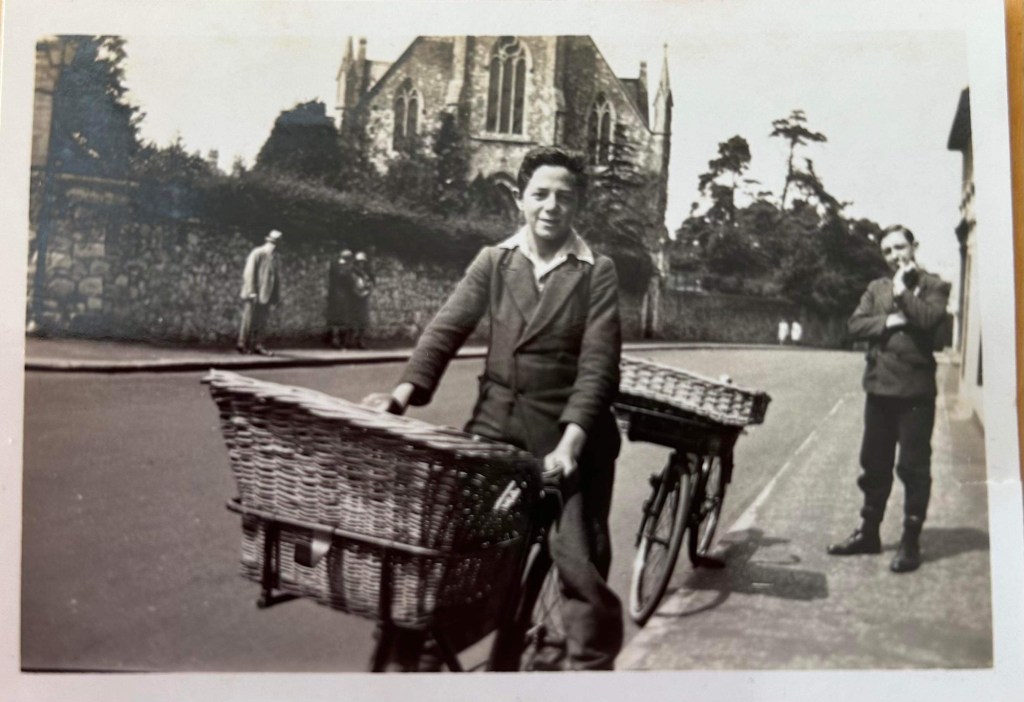
The photos feature George Mullen outside the shop, with daughter Violet and other staff. Sadly there are no names to identify the delivery boys pictured on their bikes.
Mr Mullen’s wife predeceased him in July 1945. He survived her by 6 years and died in 1951. A short obituary of this popular shopkeeper appeared in the Sevenoaks Chronicle.
George Mullen’s obituary from 1951
When Kathleen Blow finally retired a link with the Rowley brothers, and George Mullen, over a century of shopkeeping, was finally broken, but family photos like those of the Mullen family help piece together our local history.
Please do remember to click on the ‘Like’ button below if you enjoyed reading this!
The Quakers Hall Bakery stood on Quakers Hall Lane at the bottom of Cobden Road, as this photograph shows. It was in business in the early 1900s and this image has been dated to around 1912, when it was owned by Biggs Bros. The business later changed hands, and subsequently became an undertakers, before being demolished and converted into flats and houses.
Thanks to a History Hub follower who sent in some recollections of one of the family, which were printed in a magazine in the 1980s and you can read below.
…It was Hot Cross Bun time when activity was at its most hectic. The firm supplied approximately 2,000 customers and if each ordered an average of seven buns (they were sold in sevens, half a baker’s dozen?) a total of 14,000 needed to be made and delivered. All of these had to he baked in a short time – not more than 24 hours – in addition, of counse, to the bread normally baked.
Making the dough began on the Wedsesay night and continued all through Thursday, the last batch being made early on Good Friday morning. As soon as they began to come out of the oven, and when they had cooled a little, they had to be brushed over with hot meited sugar. It was at this point that all hands were enlisted.
Every member of the family, some seven or eight of us, set to work brushing the buns and then bagging them, seven to a bag. These were sold for six old pence! After a while the acrid smell of the hot sugar not only made my eyes smart but I also felt quite sick. We all had do work at great speed, and very early in the morning dozens of bags were loaded on to vans waiting in the yard, ready for the delivery men to rush them round to customers throughout the town and surrounding villages.
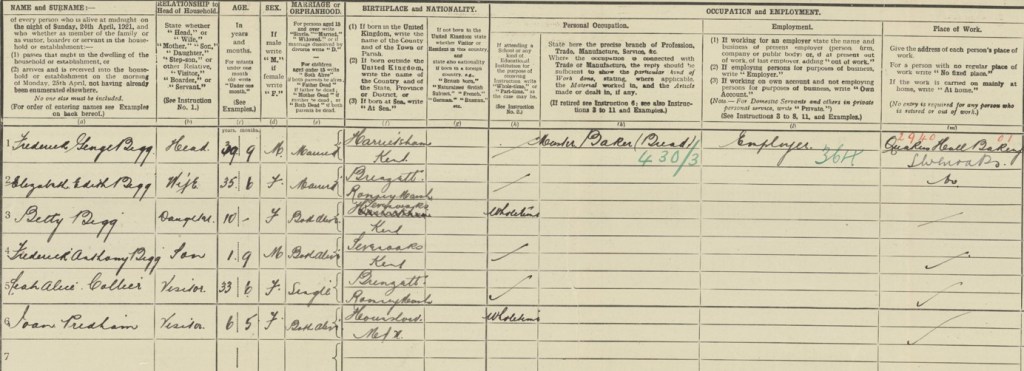
The 1921 census (c. The National Archives; findmypast 1921) shows Betty Bigg (later Pharoah) whose memories feature in this post, living at 37, Quakers Hall Lane with her father, Frederick George Bigg, a master bread baker.
At first these vans were horse-drawn, but later on motor vans, gradually introduced, enabled the operation to be further speeded up. When the last load finally left the yard a sigh of relief went up from all concerned. It was indeed a most exhausting operation but one which no-one questioned and about which no-one complained. It was taken for granted that it was important and right that the customers should come first – the firm was there to serve them. One thing is certain those who had the privilege of eating those buns thoroughly enjoynd them. They were delicious.
It was in 1932 at the end of Hot Cross Bun time that my uncle said, “That is the last batch of Hot Cross Buss for me. ” And so it was. By the next Good Friday the business had been sold and my father and his brother had retired. It in doubtful if any other baker carried on this annual mammoth task. Certain it is that no one does today. Nevertheless, I would dearly love just once more to savour the sweet smell of hot melted sugar on Hot Cross Buns and, most of all, to taste one of those delicious confections for less thas one old penny.






 Sevenoaks History Hub