Going to the Pictures: Remembering Sevenoaks’ Lost Cinemas

Today, only the Stag Theatre reminds us that Sevenoaks was once a thriving cinema town. Yet for much of the twentieth century, going “to the pictures” was one of the town’s favourite pastimes. Before television, streaming and even widespread radio ownership, thousands of local people escaped into the magic of the cinema each week.

At its peak, Sevenoaks had four cinemas serving a town that was much smaller than it is today. Each had its own character, loyal customers and stories, but all have now disappeared or found new lives.

Frank Robinson’s Vision

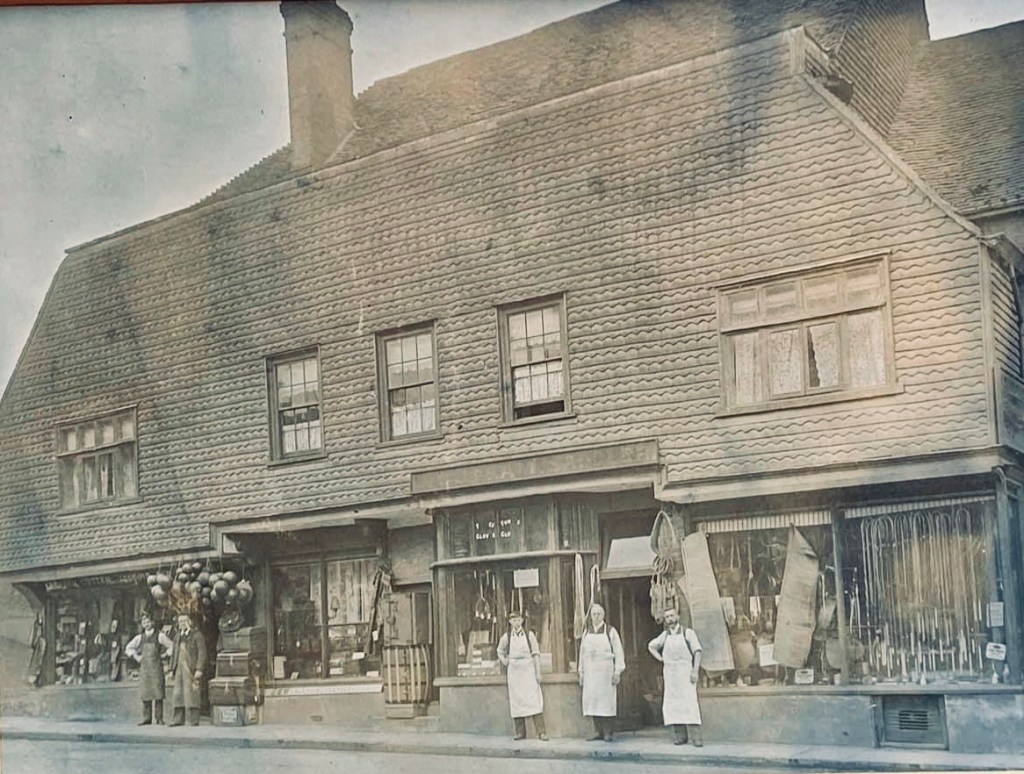
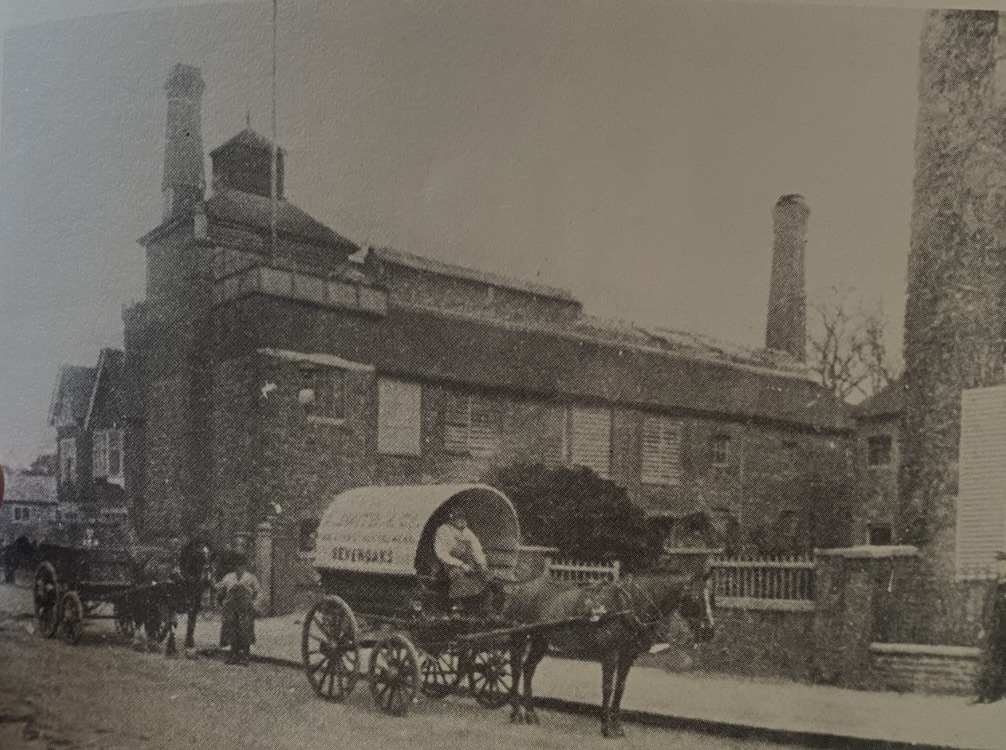
The story begins with local hotelier and councillor Frank Robinson, proprietor of the Royal Oak Hotel. Recognising the enormous potential of moving pictures, Robinson converted part of the former Smiths Brewery in the High Street into the Cinema Electric Theatre. Films were being shown there from 1910, marking the beginning of more than half a century of cinema on the site.

The old Smith’s Brewery on the High Street, which became the site of the town’s first cinema

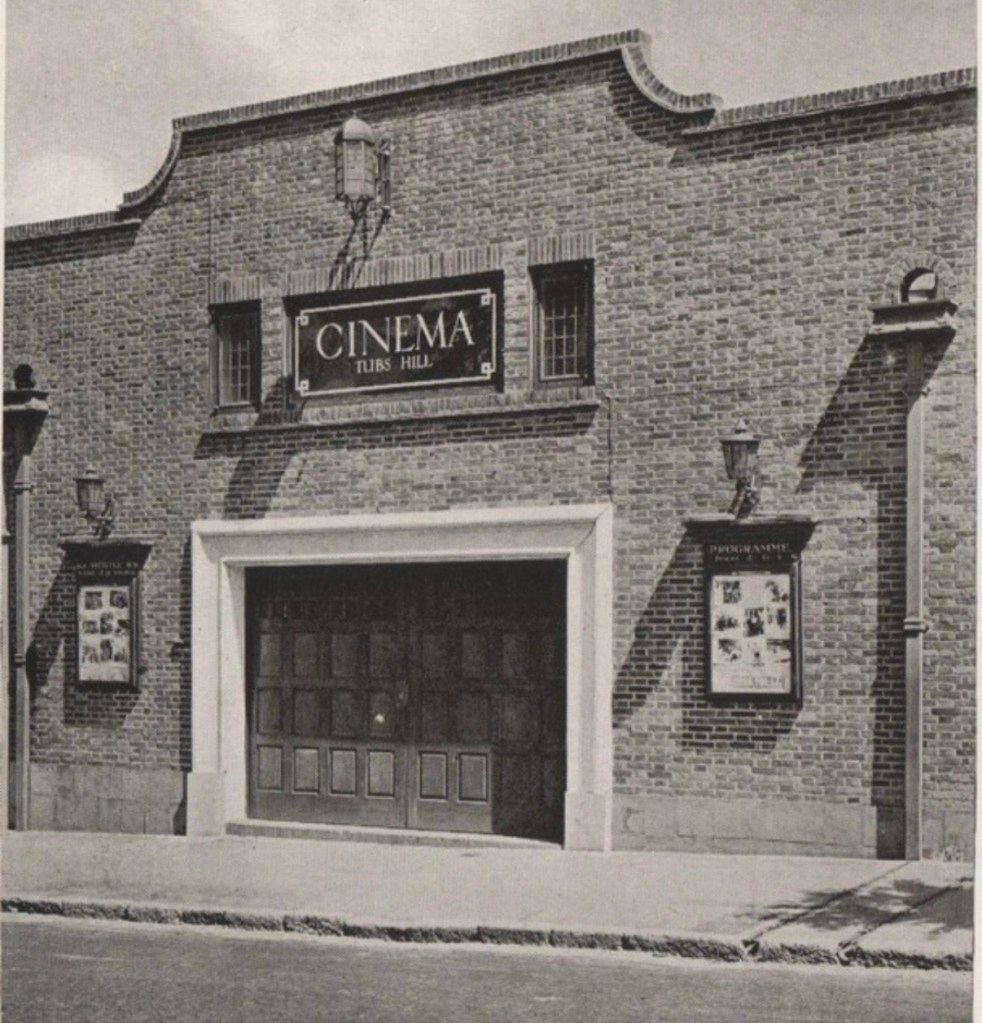
Over the following decades the town developed an impressive choice of picture houses. Alongside the Electric, which later became the Plaza and then the Granada, there was the Palace Cinema at Tubs Hill, the Majestic on London Road (later the Odeon and today’s Stag Theatre), and the Carlton on St John’s Hill.

The Tubs Hill cinema

By the late 1940s, a town the size of Sevenoaks could boast four cinemas, each serving its own neighbourhood and together offering an extraordinary variety of films and entertainment.

The former Electric Cinema after its refurbishment. It stood opposite Pembroke Road

The Electric was among the earliest purpose-built cinemas in the district and reflected the extraordinary popularity of this new form of entertainment. It was run for four years by Herbert Lethebe, nephew of owner Cllr Frank Robinson. Herbert was also the captain of Sevenoaks football team. He died during the Great War in September 1918.

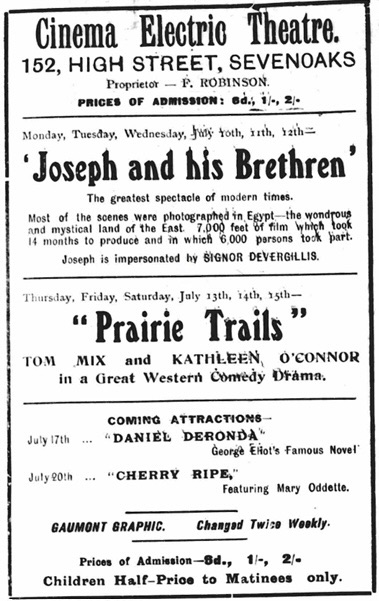
Advert for the Electric Cinema programme from the Sevenoaks Chronicle 7 July 1922

By the mid-1920s cinema technology and public expectations had moved on. The original building was remodelled in 1926 before being completely rebuilt in 1935. The impressive new cinema was officially opened by Lord Sackville and later became familiar to generations of Sevenoaks residents as the Plaza and eventually the Granada.

Following Frank Robinson’s death in 1929, the business remained in family hands under his son Richard.

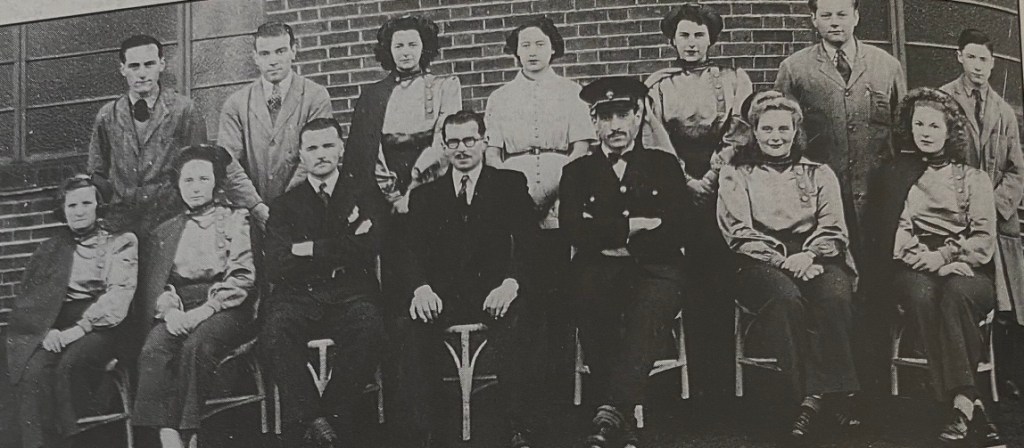
Staff of the Plaza pictured in the 1940s

Sadly, the building itself did not survive. It was demolished during the redevelopment that created Suffolk Way, leaving little physical trace of what had once been one of the town’s best-loved entertainment venues.

The Majestic becomes the Odeon

The town’s second great cinema story belongs to the Majestic on London Road.

Opened in 1936 with the film When Knights Were Bold, it represented the latest generation of cinema design. In 1943 it joined the expanding Odeon chain, becoming the Odeon Cinema that many local people still remember.

A remarkable photograph taken on VE Day in 1945 shows the cinema staff assembled outside beneath bunting and patriotic decorations celebrating the Allied victory.

Another surviving image captures the impressive entrance hall with its twin staircases leading to the café, circle and balcony—a reminder that a visit to the cinema was an occasion in itself.

Staff gather outside the Odeon on VE Day

The building survives today as the Stag Theatre, making it the only one of Sevenoaks’ historic cinema buildings still fulfilling its original purpose of entertaining audiences.

Life behind the projector

Some of the richest memories come from the men who worked behind the scenes.

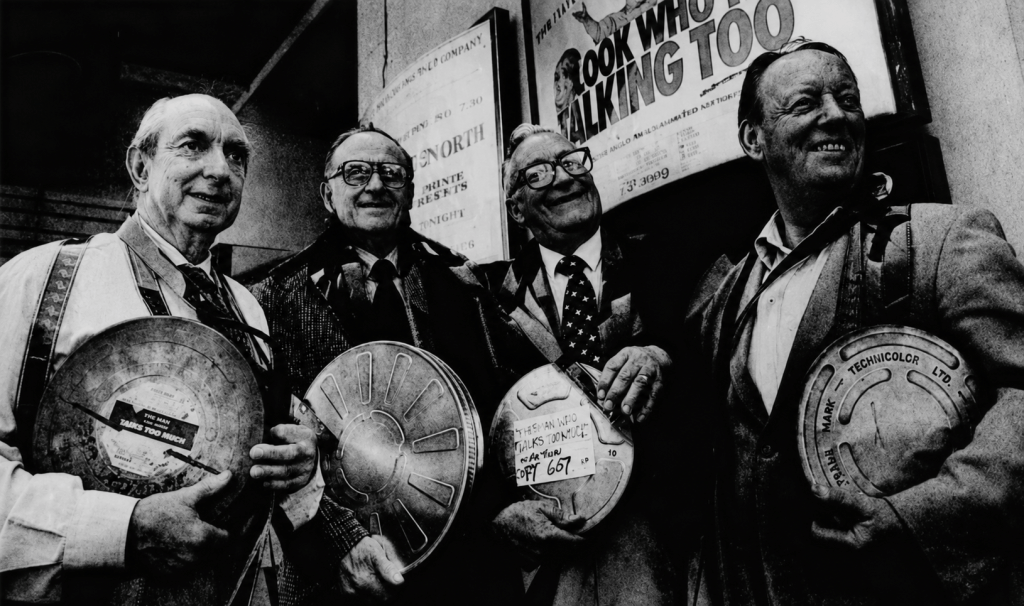
In 1991, the Sevenoaks Chronicle reunited four veteran projectionists—Douglas Julyan, Tom Barnes, Don Knight and Dave Hodges—whose combined careers stretched back to the late 1930s and early 1940s.

Together they represented the last living link with Sevenoaks’ vanished cinemas.

All had started at the bottom as rewind boys, responsible for rewinding film reels after each showing, inspecting them for damage and carefully repairing any breaks before the next performance.

At the time there were three cinemas operating in Sevenoaks, offering as many as eighteen different films in a single week. As one projectionist recalled, you could quite literally go to the pictures every evening and see a different programme.

Don Knight began work at the Plaza in 1939.

“It was hard work,” he remembered. “All I did was rewind films and polish them off. I wasn’t allowed to touch the projectors for a while.”

Eventually opportunity came unexpectedly. When the chief projectionist was suddenly called away, Don found himself running an entire programme alone.

In fact, the chief projectionist was called away on purpose so that Don might show his skills.

He knew nothing of the ploy untl the following Monday when he was called in to see the Manager. “I was promoted to the Majestic.” said Don.

Dave Hodges was 15 years old when he began work as a re-wind boy at the Carlton Cinema on St John’s Hill, in 1941.

He worked his way up to the position of second projectionist before his call-up in 1946. The Carlton, which opened in 1935, closed twenty years later in 1954.

Douglas Julyan began working at the Plaza in 1941, earning just £2.10 a week at the age of fourteen.

Left to right, Don Knight.
Douglas Julyan, Tom Barnes and Dave Hodges

He remembered projection rooms filled with cigarette smoke.

“If there was a full house there was so much cigarette smoke it was like a fog,” he recalled. “The image projected on the screen appeared light brown.”

Despite the hard work, all four men spoke fondly of those years.

“There was a better atmosphere in those days,” Douglas reflected. “Films were made for entertainment, not commercialism.”

A different world

The cinemas themselves were very different places from those we know today.

The Plaza boasted a magnificent Compton organ which rose dramatically through the stage before performances. Local organist Vic Trivass regularly entertained audiences, while visiting performers appeared between films.

The cinema even had its own restaurant overlooking the High Street, staffed by waitresses, cooks and cashiers. Uniformed attendants in smart blue outfits with gold braid greeted customers as they arrived.

Performances ran continuously from lunchtime until around eleven o’clock at night.

Even during the Second World War the cinemas rarely closed. During air raids, red warning lights would illuminate the words “Air Raid”, while a flashing green light signalled that the all-clear had been given. Remarkably, many filmgoers preferred to remain in their seats rather than leave the building.

Sevenoaks’ changing cinema audience

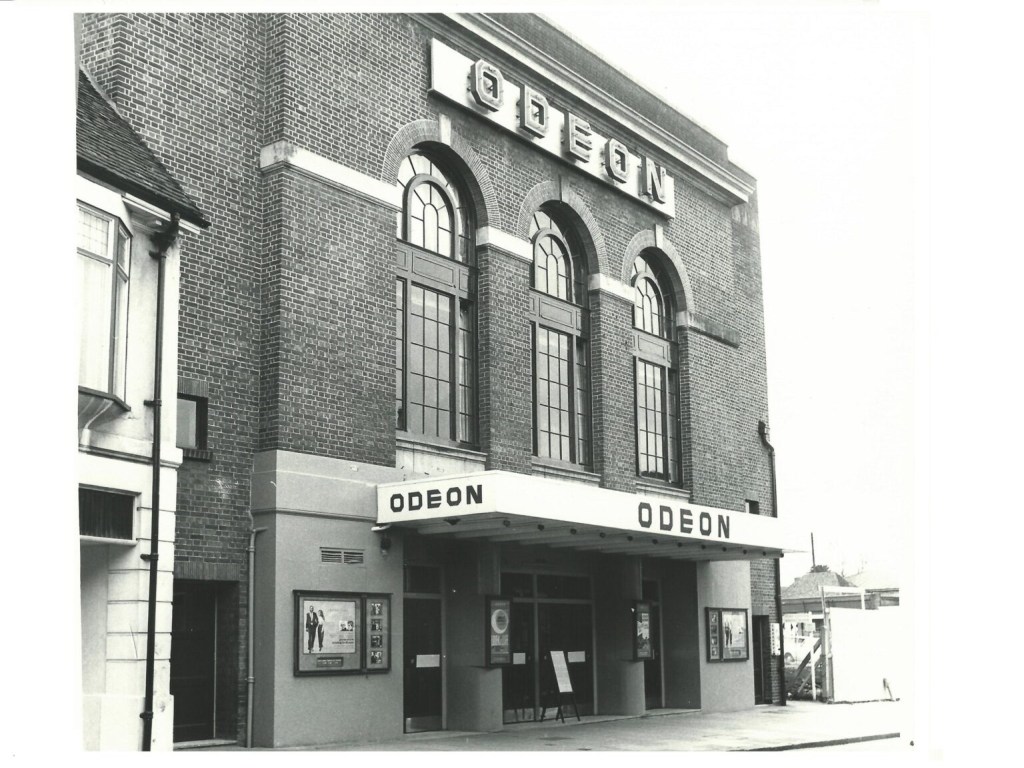
A later incarnation of the Odeon

By the late 1970s, cinema-going had changed considerably. The former Majestic—by then the Odeon and later Focus Cinemas—was competing not only with television, but with changing lifestyles and audiences. Yet the cinema remained an important part of the town’s social life.

The cinema’s manager, John Watson, observed that Sevenoaks had become “a very mixed community”, describing a distinction between the more affluent “executive” and “county” residents living “at the top of the hill” and other residents at the bottom. Reflecting on who actually came through the cinema doors each week, he concluded that “we draw the greater majority of our patronage from the ‘others’ half of the Sevenoaks populace.”

His weekly reports also reveal that Sevenoaks was very much regarded as a family town. Disney films and school holiday programmes consistently attracted the largest audiences, while staff organised children’s competitions, worked closely with the Sevenoaks Chronicle and even staged a local Star Wars painting competition to encourage families into the cinema. It was a reminder that the cinema remained far more than simply somewhere to watch a film—it was still a focal point of community life.

The Stag theatre as it looks today

The building would later become the Ace Cinema before being saved as The Stag Theatre, which has placed itself at the heart of the community, embodying many of the values described by the old projectionists. For decades, the cinemas of Sevenoaks were places where neighbours met, friendships were formed and generations of local people shared memorable experiences together.

Remembering Sevenoaks’ cinemas

Today, most traces of Sevenoaks’ lost cinemas have disappeared beneath modern development or altered beyond recognition.

Yet photographs, postcards and the memories of those who worked there remind us how important they once were—not simply as places to watch films, but as social centres where first dates began, families spent evenings together, children marvelled at Hollywood adventures and communities gathered during wartime and peace alike.

Like so much of Sevenoaks’ history, these buildings have vanished, but their stories survive through the memories of local people.

If you remember any of Sevenoaks’ cinemas, or have photographs, tickets, programmes or family stories to share, I’d love to hear from you. Every memory helps preserve another small piece of our town’s history.

If you enjoy these posts and would like to support Sevenoaks History Hub and help keep the research going, you can buy me a coffee

Sources and Further Reading

This article has been compiled from a range of contemporary newspapers, postcards, photographs, local directories and published sources, including:

  • Matthew Ball, Sevenoaks, Riverhead & Seal in Old Photos and Postcards (2023).
  • Sevenoaks Chronicle (various editions, including interviews with former projectionists, 1991).
  • David Killingray & Elizabeth Purves, Sevenoaks: An Historical Dictionary (2012).
  • John C. Watson, A Case Study of Cinema Management: The Focus Cinema, Sevenoaks (University dissertation, 1979).
  • The Stag Sevenoaks – History of the Theatre: https://stagsevenoaks.co.uk/history/
  • Personal postcard and photograph collection.

Copyright

The images reproduced here remain the copyright of their respective owners or are believed to be out of copyright. Where images are from my own collection, please credit Sevenoaks History Hub if they are reused.

The text of this article is © Sevenoaks History Hub. Please don’t reproduce it in full without permission. You’re very welcome to quote short extracts with appropriate attribution and a link back to the original article.
Book Signing, Sunday 13 October

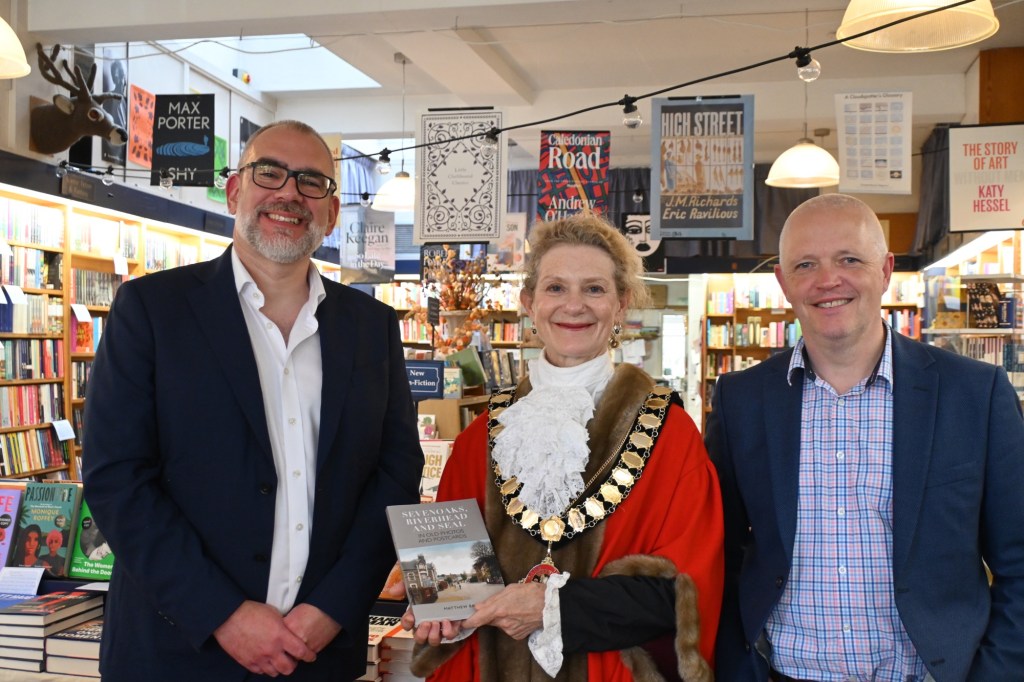
It was a great first week to launch my new book, including a photocall with the Mayor at Sevenoaks Bookshop.

Next weekend I’ll be there signing copies from 13.30-15.30 on Sunday 13.

Matthew with Cllr Ancrum, and Paul Baker of Sevenoaks Chamber of Commerce

The book is now available from the bookshop, Dovetails Vintage on Hollybush Lane, The Anchor pub, and the Hollybush Cafe.

I hope to see some of you at the signing on Sunday, but please do let me know if you can’t make it but would like a signed copy.

You can email at 7oakspostcardbook@gmail.com

or order from the bookshop https://sevenoaksbookshop.co.uk/shop/sevenoaks-riverhead-and-seal-in-old-photos-and-postcards-by-matthew-ball/

New Book Update: Coming Soon in October!

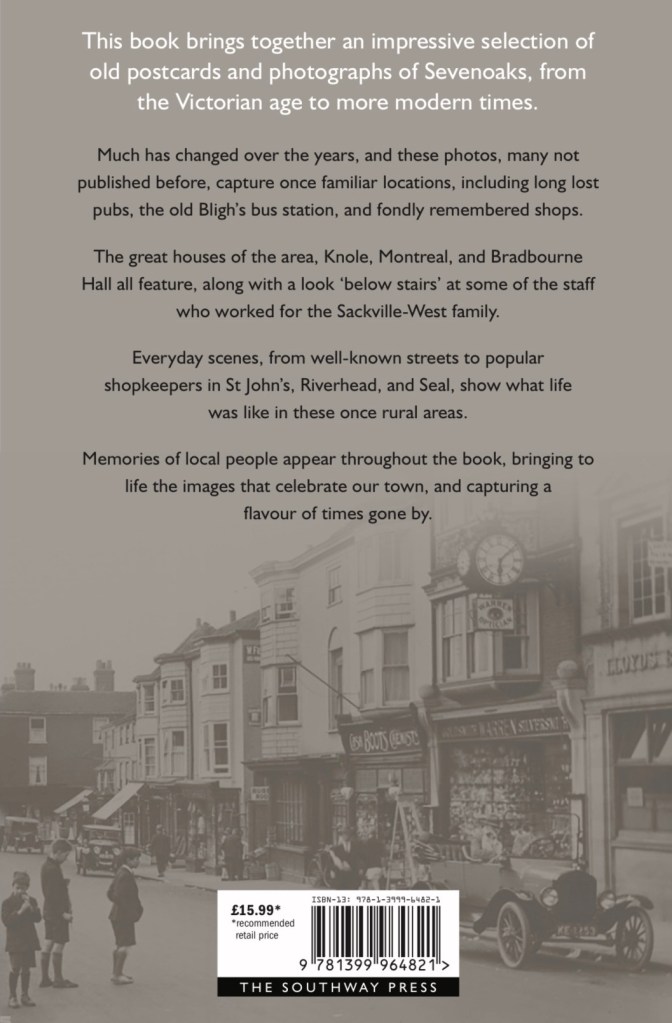
I’m really excited to reveal the cover for my new book here today.

Sevenoaks, Riverhead and Seal in Old Photos and Postcards, will be available from Sevenoaks Bookshop, from me direct (email 7oakspostcardbook@gmail.com) and other places in town.

The book will be available in October and you can pre order from the bookshop by clicking this link https://sevenoaksbookshop.co.uk/shop/sevenoaks-riverhead-and-seal-in-old-photos-and-postcards-by-matthew-ball/

If you’d like a signed copy, then it’s probably best to order from me, although I will be doing a signing event at the bookshop later in October, when it will be great to meet as many of you who can make it – details coming soon!

If you live outside the UK then you can order from the bookshop by emailing enquiries@sevenoaksbookshop.co.uk and they will quote on postage.

The book is a culmination of over two years work, and includes photos I’ve used on this page as well as lots of new ones. It also includes many of your comments. If I asked to use your comment and you gave permission, then you’re in the book, so a huge thank you to those that did!

The book was also sponsored in part by Sevenoaks Town Council and Wealden Properties. Many of the properties that feature in this book were acquired and developed by Bill Terry and he was a popular and well-known figure in the community. Bill passed away in August 2023 at the age of eighty-nine, and I am pleased that Wealden Properties has sponsored the book in his memory

I can’t wait for you to buy a copy and hear what you think.

More book updates and news shortly!

George Carnell, Some Memories of Victorian Sevenoaks

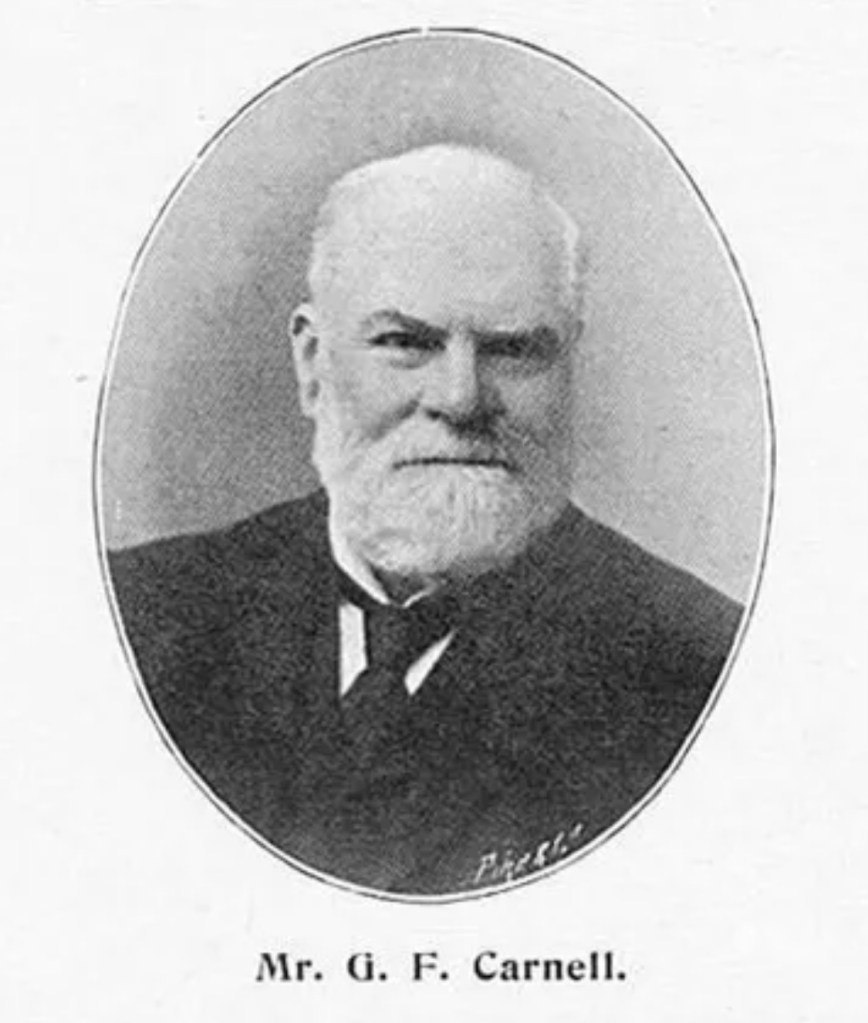
For much of the Victorian period and beyond, the Carnell family occupied a prominent place in the life of Sevenoaks. Both George Carnell (1830-1909) and his son, John Frederick (1854-1931), were solicitors. Their names can often be found in the pages of the Sevenoaks Chronicle, as they fulfilled their civic duties in a variety of roles.

While father and son took similar paths, George’s son, Francis George Carnell (1859-1915), took another. Francis, who was born in 1859, served with the military, primarily in Africa, before settling in Australia. It was here that he enlisted again during the Great War, and at fifty nine, became the oldest casualty later to be commemorated on the Sevenoaks War Memorial, when he died of his wounds at Gallipoli.

George Carnell, among numerous other roles, he was clerk to the Guardians of Sevenoaks Union, and to the Rural District Council

Toward the end of his life, George Carnell, a Fellow of the Royal Historical Society, wrote a brief memoir of the town as he remembered it over the last sixty years. I’ve reproduced it here, along with some illustrations.

Do any members of the Carnell family still live locally?

OLD SEVENOAKS.*

BY GEORGE I. CARNELL, F.R.H.S.

I have been asked by the Hon. Secretary to prepare a paper upon the changes which have taken place in the town chiefly within my own memory of upwards of sixty-three years. I will therefore take my audience on an imaginary ramble, commencing at the southern end of the town, down High Street and London Road to the South-Eastern Railway Station, then back to the junction of the two principal streets, taking in the Middle Row, and afterwards from the High Street to St. John’s. Starting from the Sole Fields at the extreme south of the town, where the battle between Jack Cade and the Royalists was fought on 24th June 1449, the beautiful estate now called Park Grange, formerly Sevenoaks Park, breaks upon our view, where stood the stone-built mansion of the Lambarde family, which was removed about half a century ago. Its noble avenue of oaks extending to the Common still remains.

Entering the town itself, we have on the left Oak End the residence of the Misses Northey, the front of which was entirely remodelled about fifty years ago; on the right the Grammar School and Almshouses; and opposite the Grammar School is Oak Lane, at the bottom of which are the Flow Fields, where formerly was a sheet of water on which I have often skated. In winter time the water flowed between the steep banks on either side, but the place is now occupied by a round formed of earth thrown up from the tunnel of the South-Eastern Railway.

Returning to the town, observe the quaint old house jutting out into the street and overhanging the footpath just beyond Oak Terrace. I have not been able to find any date upon it, but it is probably one of the oldest in the town.

Sevenoaks Church and its monuments have been lucidly and interestingly dilated upon in the description from the pen of our Rector which we have heard read to-day. I will only remark that the absence of monuments to the owners of Knole is no doubt to be accounted for by the fact of their family place of sepulchre being at Withsham

A short distance further on, just beyond a very awkward bend in the street, there used to stand the ” Old Curiosity Shop,” kept by the late Mr. John Hooper an authority in his day on old books, paintings, furniture, china, and works of art and vertu. Few persons came to Sevenoaks without going to see his collection and have a chat with the worthy proprietor.

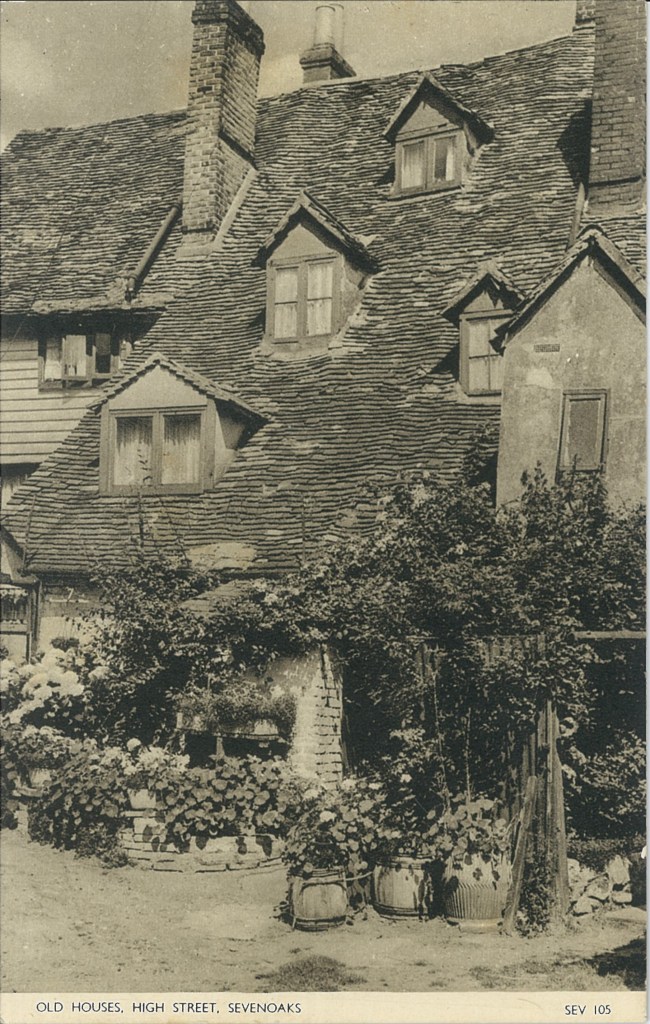
Opposite is Six Bells Lane. In the slanting roofs of the back of the houses, in the High Street at the top of this lane, are some curious attic windows, one above the other, after the style of continental towns.

The rear of 33-37, Six Bells Lane with its dormer windows

Further on, opposite the “Bricklayers’ Arms Inn,” formerly stood some old houses with rooms on the ground floor some feet below the surface of the street, the upstairs rooms being attics, from the windows of which it would have been easy to shake hands with passers-by on the pavement.

Further on is the White House, formerly the residence of Mr. Charles Willard, Clerk of the Peace for Kent, with its fluted columns and many windows. Next to the grocer’s shop (Mr. Russell’s) stood a butcher’s shop with a landway on the northern side.

These have given place to the avenue leading to the delightful residence of our churchwarden, Mr. Laurie. Next is the house and shop of Mr. Outram, leather-seller, said to have been formerly the property or residence of Archbishop Morton from 1486 to 1500.In the front may be noticed some oak carvings, and within there is a stone fire-place with the arms of the Archbishop, as well as more oak carving and panellings and very thick oak beams.

Outrams had a prominent position in London Road for many years

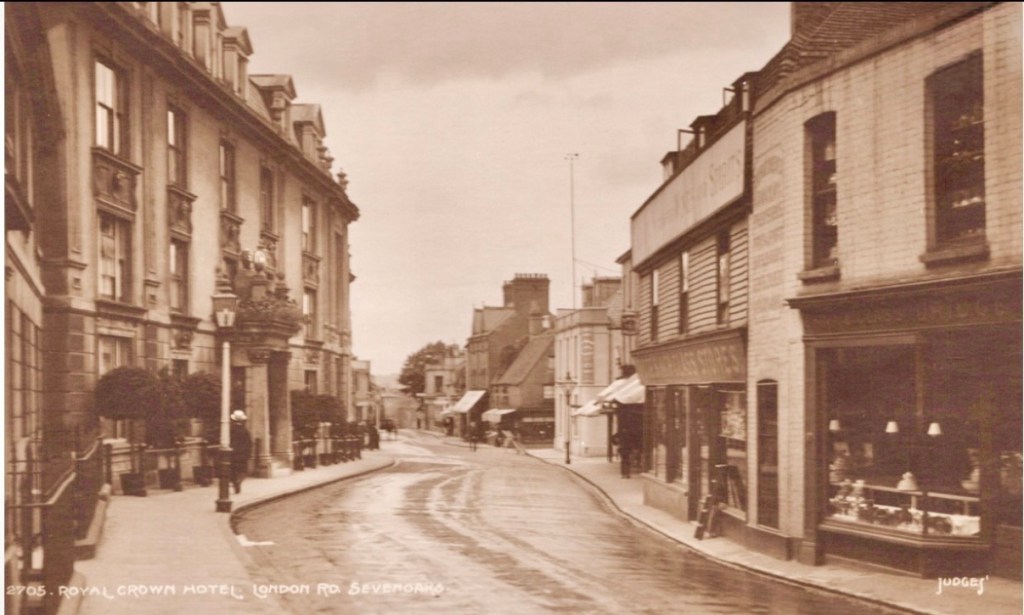
Below is the Oddfellows’ Hall, formerly called the Coffee House or Old Assembly Rooms, where the County Balls were held.

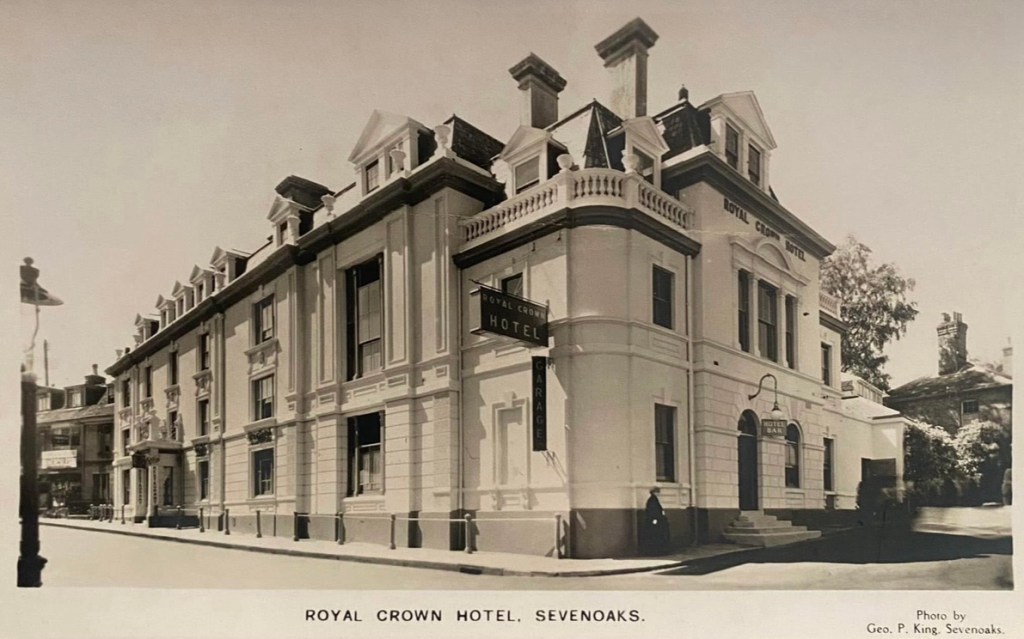
Opposite stands the Chequers Inn, from which used to start at 8 a.m. the Sevenoaks coach, “The United Friends” Peacock, coachman, who bore a striking resemblance to Mr. Tony Weller, immortalized by Dickens. Between the Oddfellows’ Hall and the Crown Hotel, some forty years ago, stood an ancient inn called The Wheatsheaf with its tea-gardens and skittle-ground.

North of the Crown, where the Granville Road commences, was a block of shops with a builder’s yard at the back, and then an alley, malodorous and pestilential, called Brand’s Lane, which formed the outlet to the Crown Fields and Kippington.

Sixty years ago the fields now occupied by South Park, the Granville, Argyle, and Gordon Roads, and the lands adjacent, were called Covell’s Farm, and used by the late Mr. William Covell.

In the field on Tubs Hill, where is now Eardley Road, a few years ago stood a windmill, a picturesque feature in the landscape. The mill-house still remains.

Returning to the junction of the London and Dartford Roads, opposite the old post-office there was formerly a pond called the Cage Pond, with a belt of trees round it.

There, in years long gone by, was a ducking- stool, a mode of punishment now happily obsolete, used upon such of the fair sex as were convicted of being common scolds, these by the wisdom of our ancestors being deemed a public nuisance.

Opposite, in front of the present Coffee Tavern, was a weighbridge, with a toll-house attached, where heavy vehicles paid toll.

Now for the Middle Row.

The square between Mr. Philpot’s shop and Mr. Ellman’s was formerly called the Butter Market. Close by, at the corner of Mr. Salmon’s Library, within the present century there stood on fair days (12th and 13th October) male and female servants waiting to be hired. Between High Street and the London Road were the shambles, with their labyrinthine passages and many openings into both streets; part was called the fish shambles and part the flesh shambles. Some remains of these are still traceable.

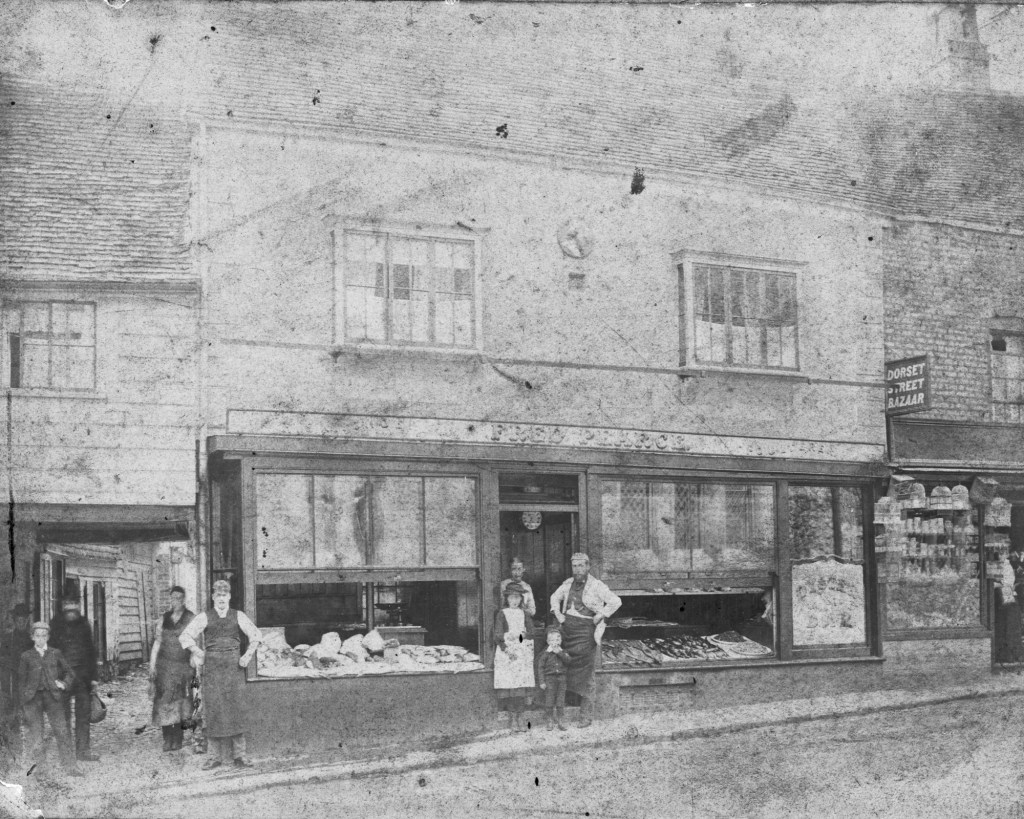
Fred Pearce outside his Dorset Street premises

In Dorset Street, in front of the shop of Mr. Pearce, fishmonger, may be seen the date 1605. The King’s head over this was put there recently by a former owner.

The ground floor of the old Market House, now used by the Y.M.C.A, was formerly open and used as a public thoroughfare, as well as occasionally by butchers and other tradesmen.

It is possible that in a building which stood on the same spot the assizes were formerly held.

From A Topography or Survey of the County of Kent, by Richard Kilburne of Hawkhurst, 1659, it appears that assizes were held at Sevenoaks as follows, viz. : before Justice Gawdy and Baron Clerk, 22nd February 1587; Baron Clerk and Queen’s Sergeant Puckering, 25th February 1590; Justices Gawdy and Kingsmill, Monday in the first week in Leut, 1600; and before Justice Bacon and Sergeant Crossfield, Sth August 1647 and 5th September 1648.

On the 1st July 1837 Our Most Gracious Majesty was proclaimed Queen in the town of Sevenoaks by my late father Thomas Carnell, who was also the Society’s first Hon. Local Secretary for the Sevenoaks District.

In the centre of the road, opposite 130 High Street, was formerly a well, now arched over. I have heard that there was a tree on each side of it, north and south. There was a pump attached to the well against the wall of Bligh’s Family Hotel. This last is an ancient building. On making some alteration a few years since a girder was discovered bearing the date 1206, but this was unfortunately removed and has been lost.

Opposite to this stood Suffolk House, formerly the residence of the Dukes of Suffolk. The mansion, which faced south, was taken down about 1820, and the terrace called Suffolk Place erected near its site.

I have heard that what is now Messrs. Smith’s brewery was formerly the stables to the mansion; on it appear the initials H. F., 1724, referring to Sir Hy. Fermor of Kippington, a former owner.

Close by, until recently, stood the Veterinary Hospital of the late Mr. John Ashton. At the back was a barn, now pulled down, which was occasionally used for theatrical purposes. Here, at an early period of his career, the great Edmund Kean is said to have performed.

The paddock of Knole formed the grounds attached to Suffolk House. The land where the Constitutional Club now stands, and the public Pleasure Grounds, I remember covered with larch trees, which gave a romantic appearance to that entrance to the town.

The Old Vine Cricket Club, in the days of a former Duke of Dorset, used to send a powerful eleven into the field. The club was revived in 1848, and still flourishes.

Below is Vine Court, now pulled down. It stood in its own paddock, and forty years ago a high-class ladies’ school was carried on there.

Some of the houses, where the five roads divide, were formerly used as barracks, whence the name Barrack Corner.

The Congregational Church and the houses on each side of St. John’s Road occupy the site of a house, now pulled down, with grounds attached. This and the neighbouring lands were formerly called Gallows Common, from the execution-place of criminals being near the top of Bradbourne Road.

On St. John’s Hill (west side), formerly called Workhouse Hill, stood the Union Workhouse, pulled down about 1846.

A short distance to the north is the mansion of Greatness, near which stood the curious silk mills, the ruins of which still remain. They were for many years carried on by the late Mr. Peter Nouaille, a name always dear to Sevenoaks. His daughter, at an advanced age, is still living at St. John’s Lodge.

I have now endeavoured to sketch the changes which have taken place in the town during the last sixty years.

In place of the post-chaises and four of the times of our grandfathers, the numerous fast coaches which passed through daily in the days of our fathers, and the circuitous railway journey via Tonbridge and Red Hill of our own earlier days, we have now a first-class railway station at each of the northern ends of our town, and Sevenoaks, lying on the direct route from London to Paris, is on the high road to the World.

So ‘the old order changeth; yielding place to new.’

New History Hub Site Launches

Welcome! I’m pleased to be launching the new website for Sevenoaks History Hub.

The Hub started and will remain on facebook, where I’ll continue to post and share a range of historical content relating to our town. This new website will allow me, and others, to write longer posts, and will bring together a range of things of interest, from local history books, to events, and all things related to the history and heritage of Sevenoaks and district.

If you have a story to tell, photographs to share, or an event to publicise, then please do get in touch. You can use the contact form on this website or email me at mattjball@icloud.com

I hope you like the site, and look forward to hearing from you.

Matt