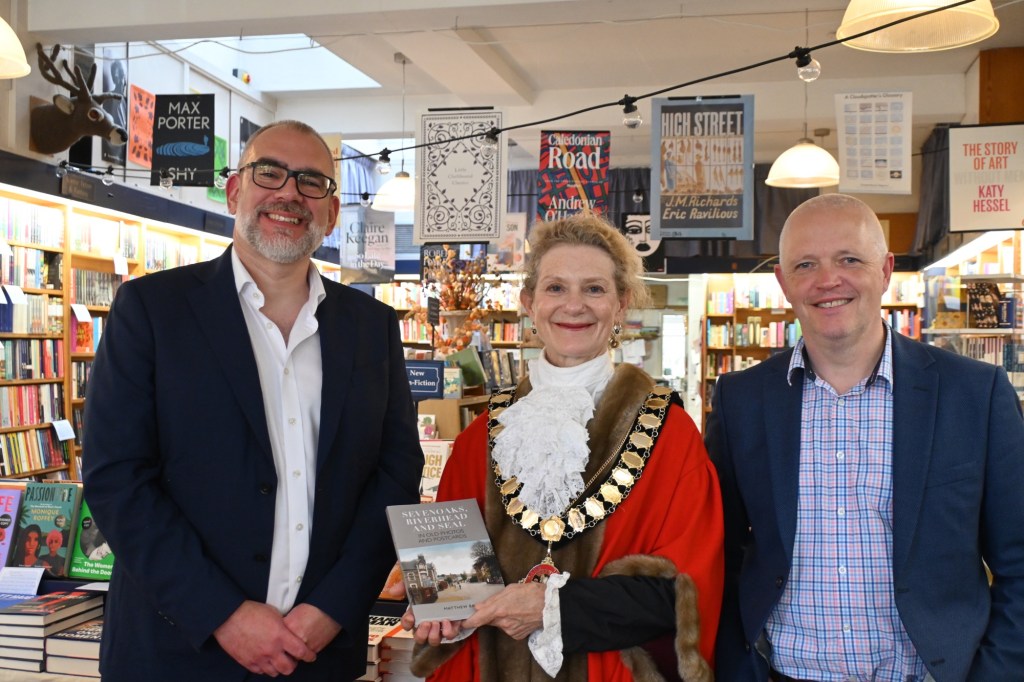
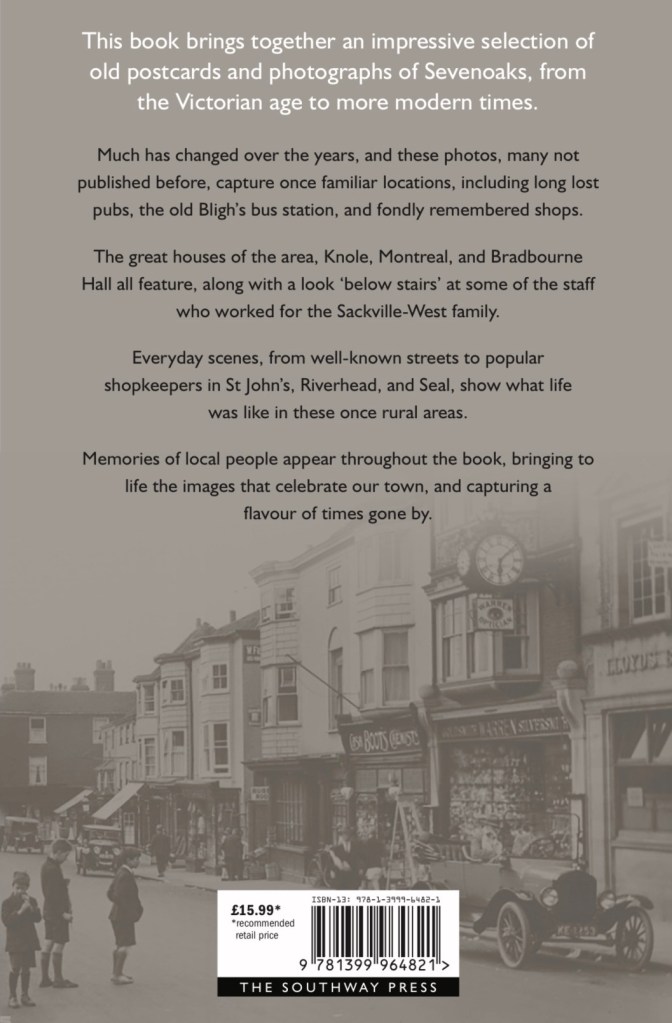
I’m really excited to reveal the cover for my new book here today.
Sevenoaks, Riverhead and Seal in Old Photos and Postcards, will be available from Sevenoaks Bookshop, from me direct (email 7oakspostcardbook@gmail.com) and other places in town.
If you’d like a signed copy, then it’s probably best to order from me, although I will be doing a signing event at the bookshop later in October, when it will be great to meet as many of you who can make it – details coming soon!
If you live outside the UK then you can order from the bookshop by emailing enquiries@sevenoaksbookshop.co.uk and they will quote on postage.
The book is a culmination of over two years work, and includes photos I’ve used on this page as well as lots of new ones. It also includes many of your comments. If I asked to use your comment and you gave permission, then you’re in the book, so a huge thank you to those that did!
The book was also sponsored in part by Sevenoaks Town Council and Wealden Properties. Many of the properties that feature in this book were acquired and developed by Bill Terry and he was a popular and well-known figure in the community. Bill passed away in August 2023 at the age of eighty-nine, and I am pleased that Wealden Properties has sponsored the book in his memory
I can’t wait for you to buy a copy and hear what you think.
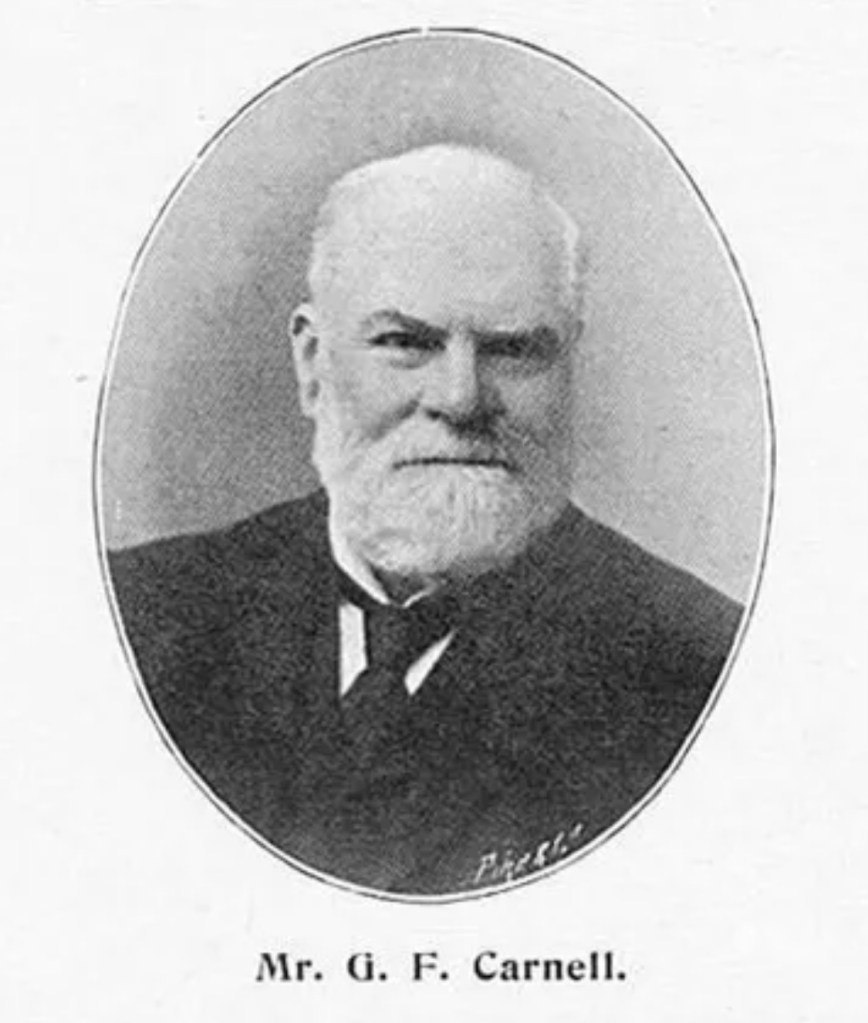
For much of the Victorian period and beyond, the Carnell family occupied a prominent place in the life of Sevenoaks. Both George Carnell (1830-1909) and his son, John Frederick (1854-1931), were solicitors. Their names can often be found in the pages of the Sevenoaks Chronicle, as they fulfilled their civic duties in a variety of roles.
While father and son took similar paths, George’s son, Francis George Carnell (1859-1915), took another. Francis, who was born in 1859, served with the military, primarily in Africa, before settling in Australia. It was here that he enlisted again during the Great War, and at fifty nine, became the oldest casualty later to be commemorated on the Sevenoaks War Memorial, when he died of his wounds at Gallipoli.
George Carnell, among numerous other roles, he was clerk to the Guardians of Sevenoaks Union, and to the Rural District Council
Toward the end of his life, George Carnell, a Fellow of the Royal Historical Society, wrote a brief memoir of the town as he remembered it over the last sixty years. I’ve reproduced it here, along with some illustrations.
Do any members of the Carnell family still live locally?
OLD SEVENOAKS.*
BY GEORGE I. CARNELL, F.R.H.S.
I have been asked by the Hon. Secretary to prepare a paper upon the changes which have taken place in the town chiefly within my own memory of upwards of sixty-three years. I will therefore take my audience on an imaginary ramble, commencing at the southern end of the town, down High Street and London Road to the South-Eastern Railway Station, then back to the junction of the two principal streets, taking in the Middle Row, and afterwards from the High Street to St. John’s. Starting from the Sole Fields at the extreme south of the town, where the battle between Jack Cade and the Royalists was fought on 24th June 1449, the beautiful estate now called Park Grange, formerly Sevenoaks Park, breaks upon our view, where stood the stone-built mansion of the Lambarde family, which was removed about half a century ago. Its noble avenue of oaks extending to the Common still remains.
Entering the town itself, we have on the left Oak End the residence of the Misses Northey, the front of which was entirely remodelled about fifty years ago; on the right the Grammar School and Almshouses; and opposite the Grammar School is Oak Lane, at the bottom of which are the Flow Fields, where formerly was a sheet of water on which I have often skated. In winter time the water flowed between the steep banks on either side, but the place is now occupied by a round formed of earth thrown up from the tunnel of the South-Eastern Railway.
Returning to the town, observe the quaint old house jutting out into the street and overhanging the footpath just beyond Oak Terrace. I have not been able to find any date upon it, but it is probably one of the oldest in the town.
Sevenoaks Church and its monuments have been lucidly and interestingly dilated upon in the description from the pen of our Rector which we have heard read to-day. I will only remark that the absence of monuments to the owners of Knole is no doubt to be accounted for by the fact of their family place of sepulchre being at Withsham
A short distance further on, just beyond a very awkward bend in the street, there used to stand the ” Old Curiosity Shop,” kept by the late Mr. John Hooper an authority in his day on old books, paintings, furniture, china, and works of art and vertu. Few persons came to Sevenoaks without going to see his collection and have a chat with the worthy proprietor.
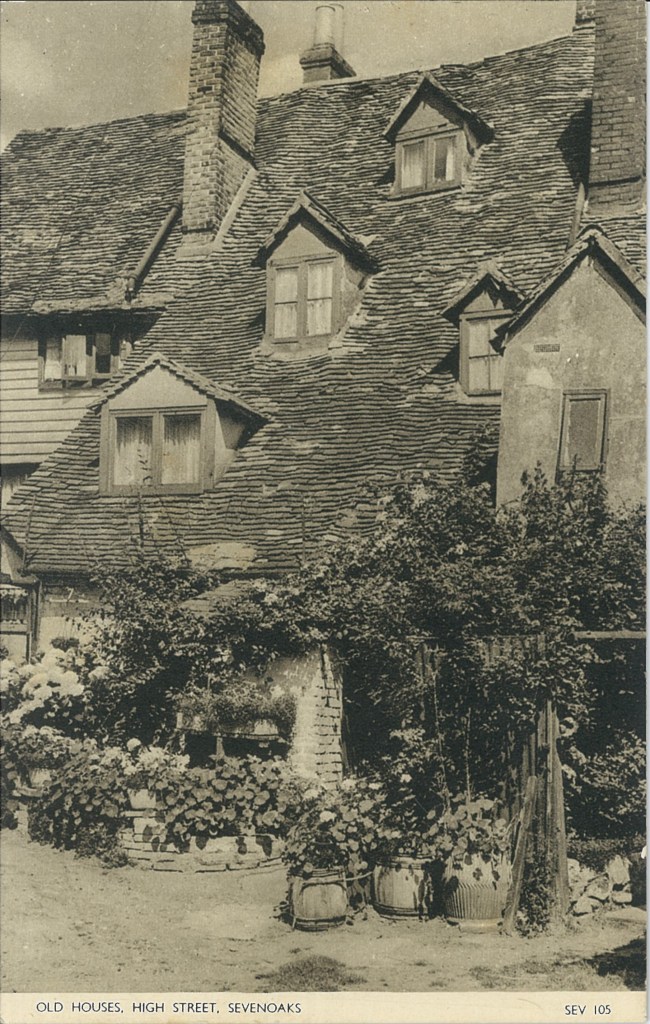
Opposite is Six Bells Lane. In the slanting roofs of the back of the houses, in the High Street at the top of this lane, are some curious attic windows, one above the other, after the style of continental towns.
The rear of 33-37, Six Bells Lane with its dormer windows
Further on, opposite the “Bricklayers’ Arms Inn,” formerly stood some old houses with rooms on the ground floor some feet below the surface of the street, the upstairs rooms being attics, from the windows of which it would have been easy to shake hands with passers-by on the pavement.
Further on is the White House, formerly the residence of Mr. Charles Willard, Clerk of the Peace for Kent, with its fluted columns and many windows. Next to the grocer’s shop (Mr. Russell’s) stood a butcher’s shop with a landway on the northern side.
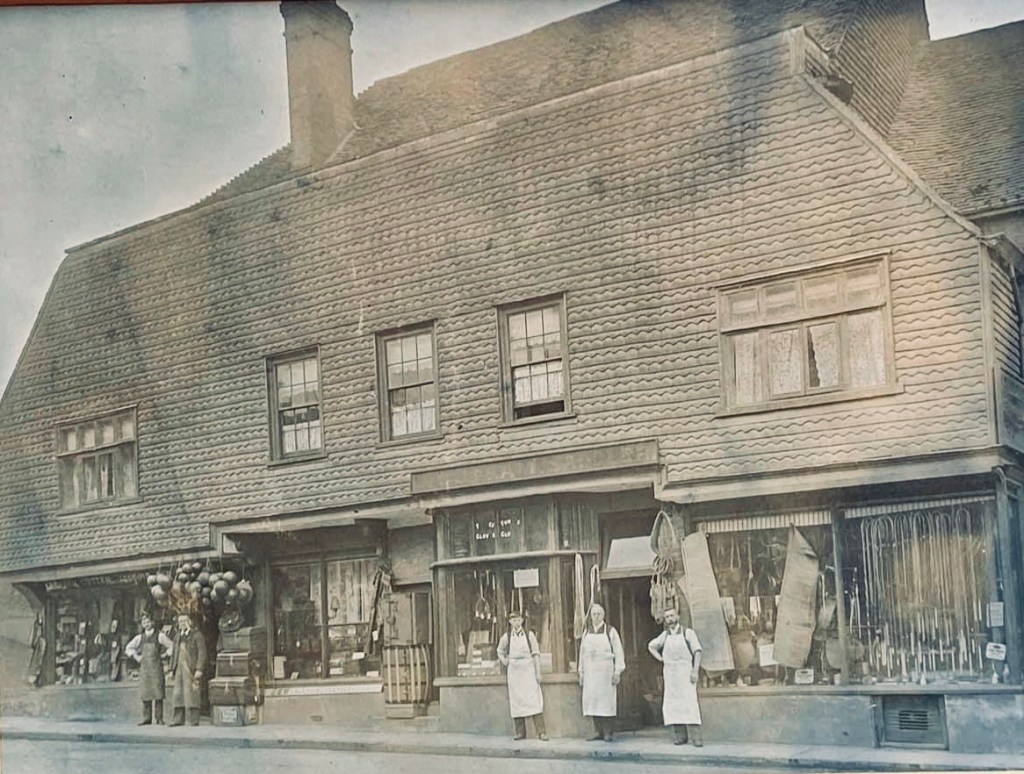
These have given place to the avenue leading to the delightful residence of our churchwarden, Mr. Laurie. Next is the house and shop of Mr. Outram, leather-seller, said to have been formerly the property or residence of Archbishop Morton from 1486 to 1500.In the front may be noticed some oak carvings, and within there is a stone fire-place with the arms of the Archbishop, as well as more oak carving and panellings and very thick oak beams.
Outrams had a prominent position in London Road for many years
Below is the Oddfellows’ Hall, formerly called the Coffee House or Old Assembly Rooms, where the County Balls were held.
Opposite stands the Chequers Inn, from which used to start at 8 a.m. the Sevenoaks coach, “The United Friends” Peacock, coachman, who bore a striking resemblance to Mr. Tony Weller, immortalized by Dickens. Between the Oddfellows’ Hall and the Crown Hotel, some forty years ago, stood an ancient inn called The Wheatsheaf with its tea-gardens and skittle-ground.
North of the Crown, where the Granville Road commences, was a block of shops with a builder’s yard at the back, and then an alley, malodorous and pestilential, called Brand’s Lane, which formed the outlet to the Crown Fields and Kippington.
Sixty years ago the fields now occupied by South Park, the Granville, Argyle, and Gordon Roads, and the lands adjacent, were called Covell’s Farm, and used by the late Mr. William Covell.
In the field on Tubs Hill, where is now Eardley Road, a few years ago stood a windmill, a picturesque feature in the landscape. The mill-house still remains.
Returning to the junction of the London and Dartford Roads, opposite the old post-office there was formerly a pond called the Cage Pond, with a belt of trees round it.
There, in years long gone by, was a ducking- stool, a mode of punishment now happily obsolete, used upon such of the fair sex as were convicted of being common scolds, these by the wisdom of our ancestors being deemed a public nuisance.
Opposite, in front of the present Coffee Tavern, was a weighbridge, with a toll-house attached, where heavy vehicles paid toll.
Now for the Middle Row.
The square between Mr. Philpot’s shop and Mr. Ellman’s was formerly called the Butter Market. Close by, at the corner of Mr. Salmon’s Library, within the present century there stood on fair days (12th and 13th October) male and female servants waiting to be hired. Between High Street and the London Road were the shambles, with their labyrinthine passages and many openings into both streets; part was called the fish shambles and part the flesh shambles. Some remains of these are still traceable.
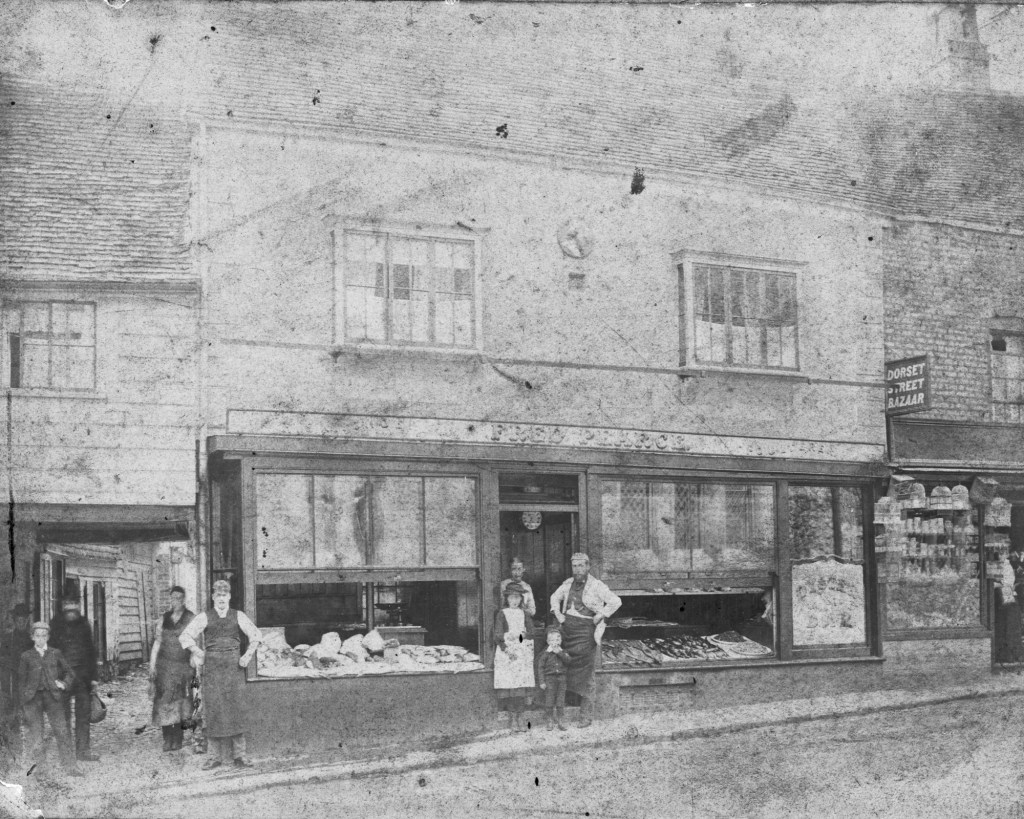
Fred Pearce outside his Dorset Street premises
In Dorset Street, in front of the shop of Mr. Pearce, fishmonger, may be seen the date 1605. The King’s head over this was put there recently by a former owner.
The ground floor of the old Market House, now used by the Y.M.C.A, was formerly open and used as a public thoroughfare, as well as occasionally by butchers and other tradesmen.
It is possible that in a building which stood on the same spot the assizes were formerly held.
From A Topography or Survey of the County of Kent, by Richard Kilburne of Hawkhurst, 1659, it appears that assizes were held at Sevenoaks as follows, viz. : before Justice Gawdy and Baron Clerk, 22nd February 1587; Baron Clerk and Queen’s Sergeant Puckering, 25th February 1590; Justices Gawdy and Kingsmill, Monday in the first week in Leut, 1600; and before Justice Bacon and Sergeant Crossfield, Sth August 1647 and 5th September 1648.
On the 1st July 1837 Our Most Gracious Majesty was proclaimed Queen in the town of Sevenoaks by my late father Thomas Carnell, who was also the Society’s first Hon. Local Secretary for the Sevenoaks District.
In the centre of the road, opposite 130 High Street, was formerly a well, now arched over. I have heard that there was a tree on each side of it, north and south. There was a pump attached to the well against the wall of Bligh’s Family Hotel. This last is an ancient building. On making some alteration a few years since a girder was discovered bearing the date 1206, but this was unfortunately removed and has been lost.
Opposite to this stood Suffolk House, formerly the residence of the Dukes of Suffolk. The mansion, which faced south, was taken down about 1820, and the terrace called Suffolk Place erected near its site.
I have heard that what is now Messrs. Smith’s brewery was formerly the stables to the mansion; on it appear the initials H. F., 1724, referring to Sir Hy. Fermor of Kippington, a former owner.
Close by, until recently, stood the Veterinary Hospital of the late Mr. John Ashton. At the back was a barn, now pulled down, which was occasionally used for theatrical purposes. Here, at an early period of his career, the great Edmund Kean is said to have performed.
The paddock of Knole formed the grounds attached to Suffolk House. The land where the Constitutional Club now stands, and the public Pleasure Grounds, I remember covered with larch trees, which gave a romantic appearance to that entrance to the town.
The Old Vine Cricket Club, in the days of a former Duke of Dorset, used to send a powerful eleven into the field. The club was revived in 1848, and still flourishes.
Below is Vine Court, now pulled down. It stood in its own paddock, and forty years ago a high-class ladies’ school was carried on there.
Some of the houses, where the five roads divide, were formerly used as barracks, whence the name Barrack Corner.
The Congregational Church and the houses on each side of St. John’s Road occupy the site of a house, now pulled down, with grounds attached. This and the neighbouring lands were formerly called Gallows Common, from the execution-place of criminals being near the top of Bradbourne Road.
On St. John’s Hill (west side), formerly called Workhouse Hill, stood the Union Workhouse, pulled down about 1846.
A short distance to the north is the mansion of Greatness, near which stood the curious silk mills, the ruins of which still remain. They were for many years carried on by the late Mr. Peter Nouaille, a name always dear to Sevenoaks. His daughter, at an advanced age, is still living at St. John’s Lodge.
I have now endeavoured to sketch the changes which have taken place in the town during the last sixty years.
In place of the post-chaises and four of the times of our grandfathers, the numerous fast coaches which passed through daily in the days of our fathers, and the circuitous railway journey via Tonbridge and Red Hill of our own earlier days, we have now a first-class railway station at each of the northern ends of our town, and Sevenoaks, lying on the direct route from London to Paris, is on the high road to the World.
So ‘the old order changeth; yielding place to new.’
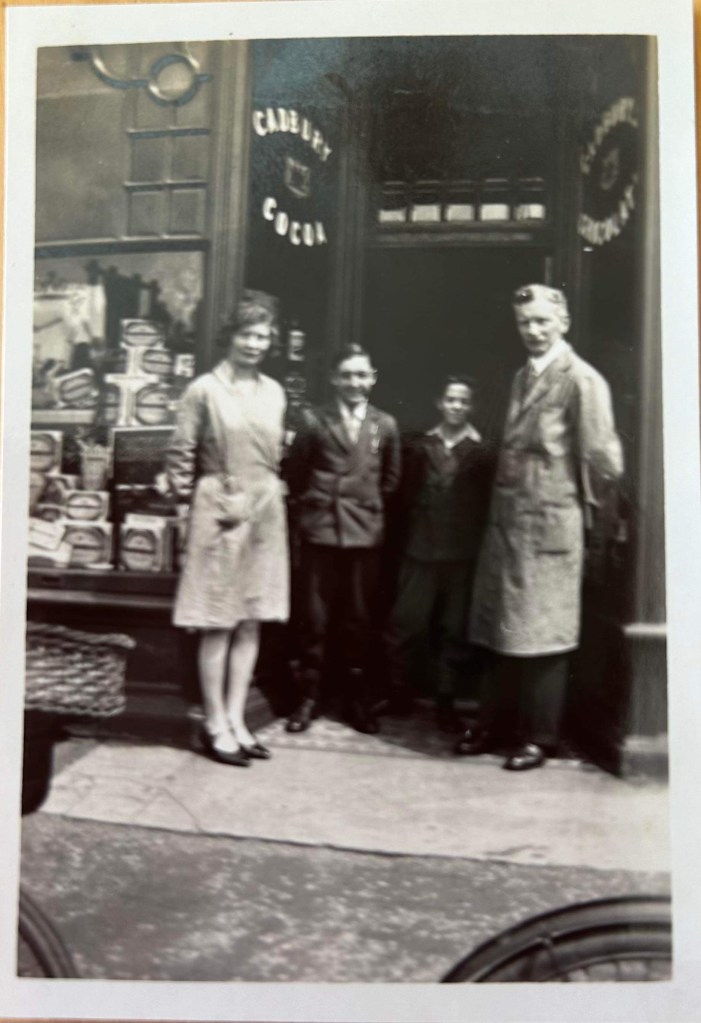
One follower of the History Hub Facebook page has sent some photos of 6, St John’s Hill, a shop which was run for many years by his great grandfather, George Harry Mullen.
Before Mr Mullen took over the shop, he worked for Frank Rowley, the then owner.
Mullen had featured in the pages of the Chronicle toward the end of the Great War, when his case was heard before a military tribunal to determine whether he should be granted an exemption from war service because of his vital work on the Home Front.
George Mullen appeared before the tribunal in June 1918. The paper reported that he was the manager of a grocery business in St John’s for his employer, Mr Frank Rowley. Aged forty four, he had been classified as grade 2 and his appeal had been supported by the Local Food Control Committee (by casting vote of the Chairman). A solicitor for Mr Rowley stated that he had had bad health for two years and had 700 registered customers for sugar (now rationed, along with many other items).
Mr Mullen had managed the business and been with him for twenty two years. The paper reported that there were two other shops and the other manager was not fully qualified. It was revealed that George Mullen was a member of the International Bible Students’ Association and conducted meetings at Tunbridge Wells. He was questioned on the information that he had a son of eighteen serving in the navy, replying that he allowed his son to hold his own opinions.
Rowley’s solicitor argued that if Mullen were taken, the business would have to close down as he was not fit enough to run it on his own and he could get no one else capable to run it for him.The Tribunal dismissed the appeal but gave 56 days before call up in view of Mr Rowley’s condition. However it seems that the war ended before Mr Mullen was called up.
Frank Rowley died a few years after the war in 1922.
Frank Rowley’s obituary in the Sevenoaks Chronicle
Rowley’s obituary contains some interesting information on the origins of the business, dating from the early 1870s.
Deceased’s career date back to some fifty years ago, when he launched out with his brother at the original shop in Cedar Terrace, St. John’s, which is still being carried on as a branch establishment. Later he removed to London, where for some time he was identified with a bakery business, and on the death of his brother about 35 years ago he assumed sole charge of the shop at the top of St. John’s Hill. Here he effected extensive improvements to the premises, including a fine new frontage, and made his stores among the smartest and best appointed in the whole district. For the last ten years, however, he took no active part in the business, failing health compelling him to give up the reins to younger hands.
More detail can be found in the obituary for Frank Rowley’s brother, Henry. Henry Rowley was a popular tradesman but took his own life in 1891, aged forty nine. The incident was the subject of a long report in the Chronicle which stated that Henry Rowley had been a grocer of long-standing at Gladstone Place, St John’s, with another shop at 6, Cedar Terrace, and premises in the High Street.
An advertisement for H.W.Rowley from 1884
Interestingly, one of Henry’s shop assistants, who gave evidence at the inquest into his death (held at the nearby Greyhound Inn) was Joseph Blow, who later had his own shop on Dartford Terrace, which continued to be run by his daughter Kathleen after his own death.
George Mullen took over the business with his wife, Mary in 1922 after his employee’s demise. The couple also had a daughter, Violet (pictured below with her father), and son, Eric.
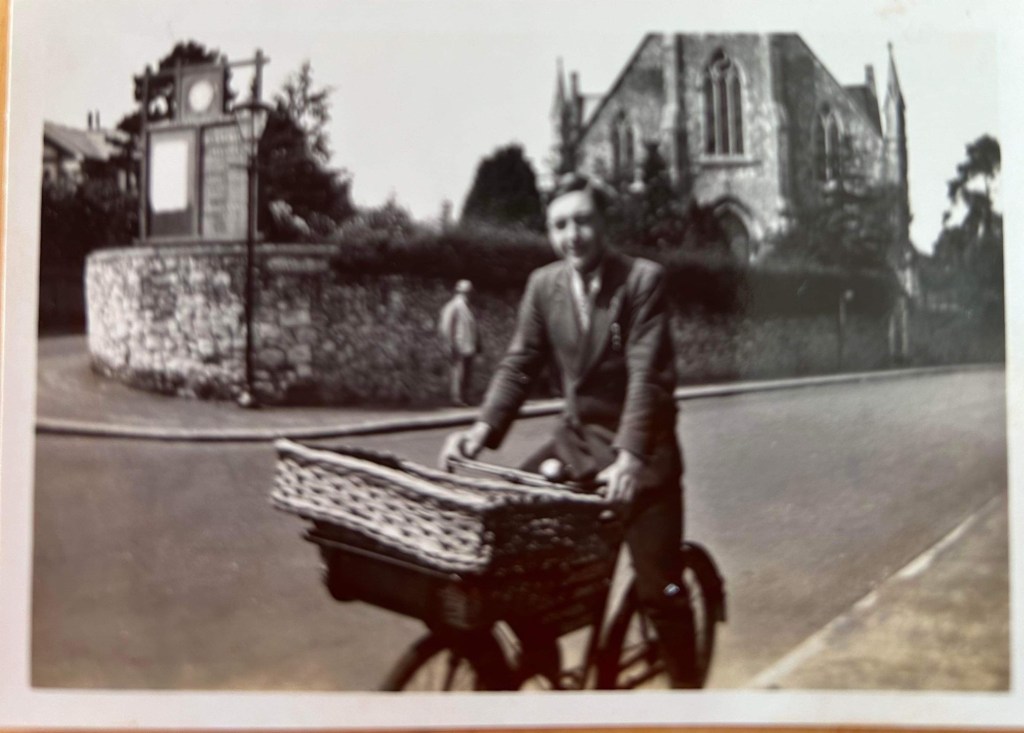
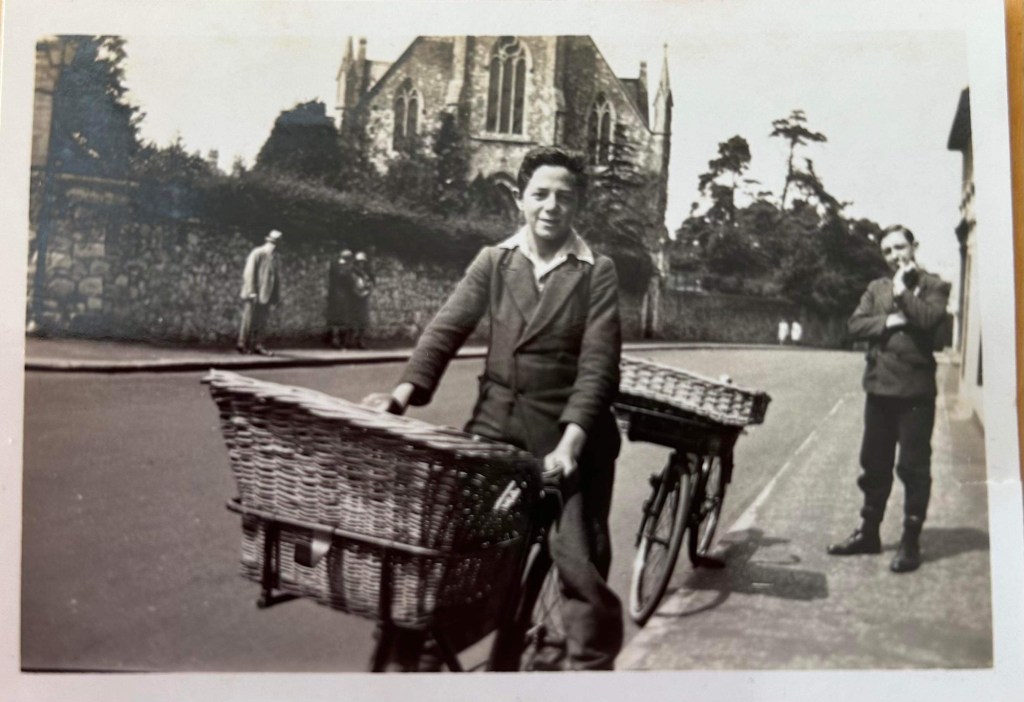
The photos feature George Mullen outside the shop, with daughter Violet and other staff. Sadly there are no names to identify the delivery boys pictured on their bikes.
Mr Mullen’s wife predeceased him in July 1945. He survived her by 6 years and died in 1951. A short obituary of this popular shopkeeper appeared in the Sevenoaks Chronicle.
George Mullen’s obituary from 1951
When Kathleen Blow finally retired a link with the Rowley brothers, and George Mullen, over a century of shopkeeping, was finally broken, but family photos like those of the Mullen family help piece together our local history.
Please do remember to click on the ‘Like’ button below if you enjoyed reading this!





 Sevenoaks History Hub